Acupuncture
Acupuncture explained
Acupuncture has been actively used for well over 2000 years.
- Acupuncture is globally recognised for its many health benefits.
- Acupuncture treats the body as a whole and connects the mental and physical aspects of the body together.
In ancient China it was believed that a person in good health had an abundance of vital energy – known as ‘Qi’ (pronounced ‘chee’) flowing well throughout their body within different ‘channels’.

“The natural healing force within each of us is the greatest force in getting well.”
― Hippocrates
Our world today is much more hectic, polluted and stressful – but our bodies still work on these same ancient principles, hence, our ‘Qi’ can easily become depleted or even stuck which ultimately causes a blockage or blockages within the body.
Blockages can often leave the body in a state of ‘dis-ease’.
Acupuncture helps the body and our ‘Qi’ return to its natural balanced free-flowing state, often leaving the patient with much improved general feelings of well-being whilst feeling less stressed, alongside a reported reduction of their original symptoms.
Acupuncture involves the insertion of very fine needles into specific points along the body which have been identified in affecting the flow of the body’s ‘Qi’.
Acupuncture is also effective in releasing tension in different areas of the body and in stimulating the release of the body’s natural pain receptor, ‘feel good’ hormones and chemicals.
In the context of ME/CFS, Fibromyalgia and Long Covid, acupuncture may:
- Support autonomic balance (between the sympathetic and parasympathetic systems)
- Improve blood flow and circulation
- Calm palpitations and anxiety
- Reduce headaches, migraines, and fatigue
- Regulate digestion and nausea
- Encourage better sleep and relaxation
- Restore overall energy balance and resilience
Conditions which Acupuncture can help with include:
- Acne
- Allergic rhinitis
- Anxiety
- Angina & Heart Disease
- Asthma
- Back Pain
- Bell’s Palsy
- Chronic Fatigue Syndrome – CFS
- Dementia
- Dentistry
- Depression
- Diabetes Type II & Gestational
- Dizziness and vertigo
- Dysmenorrhoea
- Eczema & Psoriasis
- Endometriosis
- Facial Pain
- Fibromyalgia
- Frozen shoulder
- Gout
- Headache Migraine
- HIV infection
- Hypertension
- Incontinence: urinary
- Infertility IVF
- Insomnia
- Neck pain
- ME / CFS
- Mental Health Issues
- Osteoarthritis – Knee
- Post traumatic stress disorder
- Postural Orthostatic Tachycardia Syndrome – PoTS
- Stroke
Do Acupuncture needles hurt?
For many people who have never had acupuncture, the thought of having needles inserted into their body can be daunting. However, in reality an acupuncture needle is tiny and very often an acupuncture treatment is completely painless.
Modern Acupuncture Needles
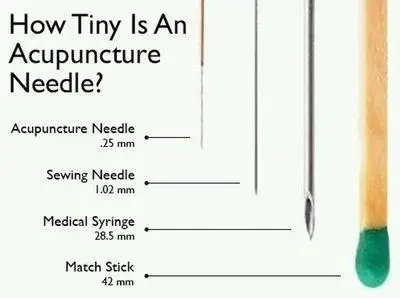
Modern day acupuncture needles are sterile and disposable. They have different gauges (thicknesses) and lengths. Acupuncture needles are tiny in comparison to other items such as a sewing needle, a medical syringe or a matchstick. The picture in this section offers a comparison to demonstrate the size of an acupuncture needle when measured against the items listed above.
Acupuncture is generally very safe with serious side effects being reported very rarely – less than 1 per 10,000 treatments.